


An introduction to 3D printed fabrics
3D printing consists of manufacturing solid three-dimensional figures from models generated by computers using various processes. One of its most important characteristics is that it is an additive process, creating shapes by manipulating material in layers that are superimposed on top of each other. The first 3D printer design was created in 1984 by Chuck Hull of 3D Systems Corp. However, the evolution and accessibility of the technology has been very gradual until recently, due, among other things, to the exclusivity of patents. Having now evolved quite a bit, 3D printing offers affordable and sustainable opportunities for fabric prototyping and manufacturing.
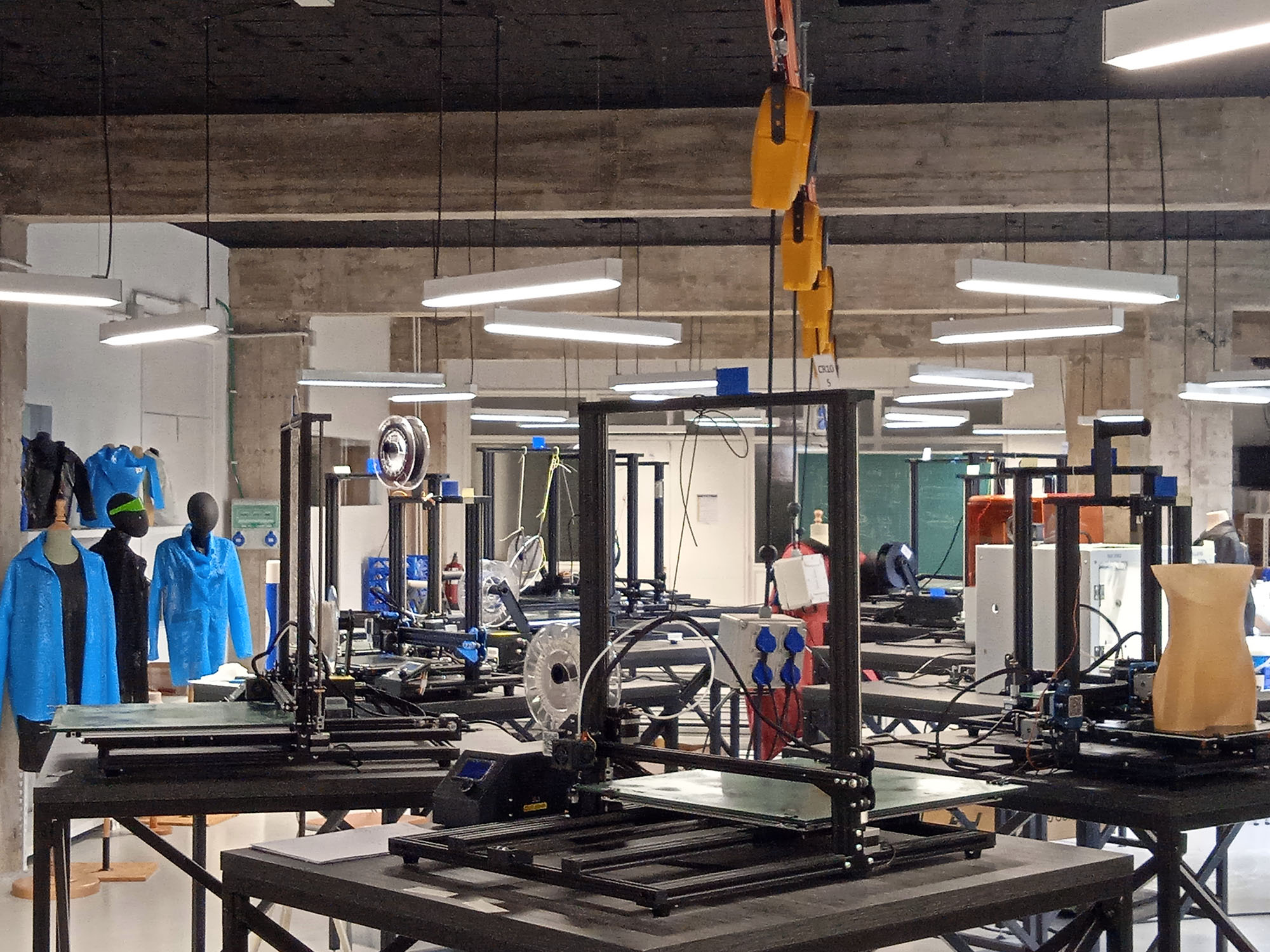
3D printing space in Balab – AEG
3D printing in the sustainable development of textile processes
Using low-cost devices, rapid and accurate prototypes can be created for sectors such as casual fashion, healthcare, and workwear. But there are two major things to consider – which printer, and which material.
Choosing the right 3D printer. Assuming we are looking for low-cost devices, we can opt for FDM (Fused Deposition Modelling) or DLP (Digital Light Processing) 3D printers, as they are the most affordable compared to other 3D printing technologies. These printers are suitable for producing fabric prototypes in plastic or other similar materials.

3D printers used in the manufacturing of all the fabrics, trimmings and rest of objects depicted in the picture gallery above.
(Photo: Carlos Alonso, Textile Dep., Centro de Estudios AEG-Ikastetxea)
The choice of printing material is the other crucial element for the textile sector. When selecting a 3D printer, you need to ensure that it is compatible with flexible and elastic materials, such as TPU (thermoplastic polyurethane) or TPE (thermoplastic elastomer). These materials allow the printing of textile prototypes that resemble real fabrics in terms of flexibility and feel and can be obtained from other used objects, contributing to recycling efforts and hence sustainability. For instance, you can recycle food packaging, waterproof clothing, CDs and DVDs, cable insulation, water bottles to obtain TPU for your 3D printing filaments.
What skills do I need to use a 3D printer?
Operating a 3D printer requires a minimum level of technical knowledge, which varies depending on the printer model. Although it is not complex, it is not as simple as the name suggests. However, the main obstacle lies in creating the design to be printed. In order to create the design from scratch, knowledge of a 3D design programme (Blender, which is free, Solidworks, Rhinoceros 3D, etc.) is required.
Fortunately, there are websites such as Thingiverse and 3D CAD Browser with libraries containing a multitude of pre-designed products that can be downloaded for free. Therefore, not having knowledge of design software should not prevent us from taking advantage of the resources offered by a 3D printer.
Prototype design and validation textiles with 3D printers
When it comes to prototype design, in order to obtain optimal results, it is important to take into account the principles of prototype design specific to the textile sector. Above all, we must consider the shape, structure and details necessary for the type of garment we are going to produce. We can use several programs, like the free Tinkercad, Openscad, Freecad, or 3D Max Autodesk.
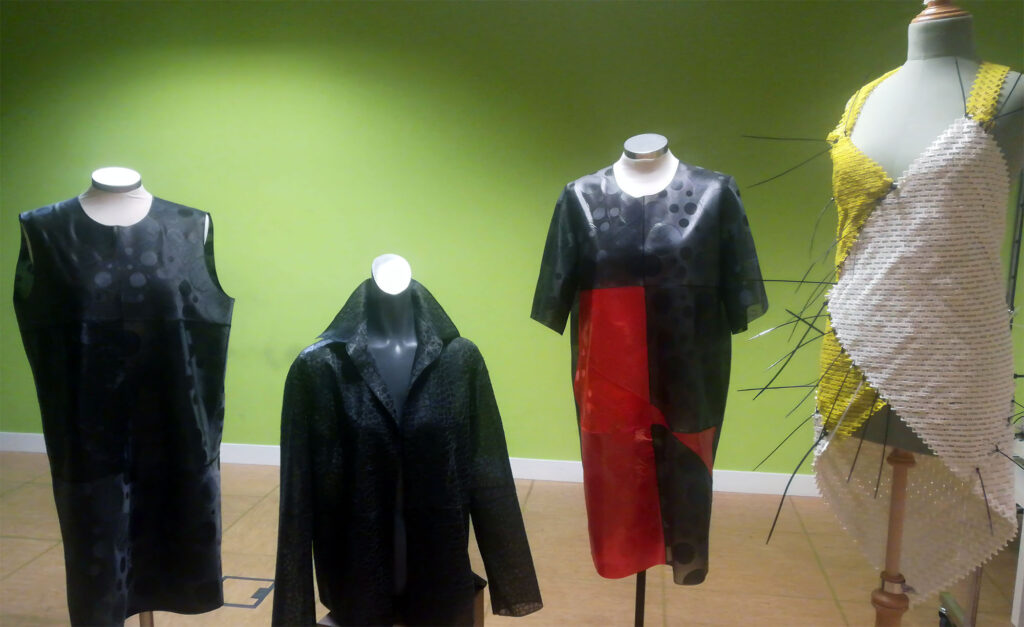
A collection of 3D casual fashion clothing in different colours, shapes and textures and
some Textile students below sporting the garments created with 3D printed fabrics and trimmings.
(Photos: Carlos Alonso, Textile Dep., Centro de Estudios AEG-Ikastetxea)
Once the design has been created, we must validate it. 3D manufacturing allows us to make any changes quickly in the design process and make adjustments as necessary. The first step is to print a prototype (one of the parts of the garment to be 3D printed) to evaluate its fit, comfort and functionality. This will help us to validate the designs and make improvements before moving on to mass production, if necessary. Today, mass production is very complicated due to many factors, but it is very suitable for small or customised productions.
Manufacturing textiles with 3D printers
3D manufacturing gives us a significant advantage in terms of customisation and adaptation, i.e. the ability to customise and adapt products to the specific needs of our customers. We can create unique objects that meet individual preferences such as customised compression garments for health purposes, work uniforms adapted to occupational needs, or fabrics for casual fashion clothing.
Before taking prototypes into a bigger production, it is important to carry out performance tests. This involves evaluating the strength, durability and other technical aspects of 3D-printed garments to ensure that they meet the standards required for their specific sector. All of this is improving day by day. At present, it has not been possible to characterise filament with certain textures and fabric behaviours, but progress is being made in this area.
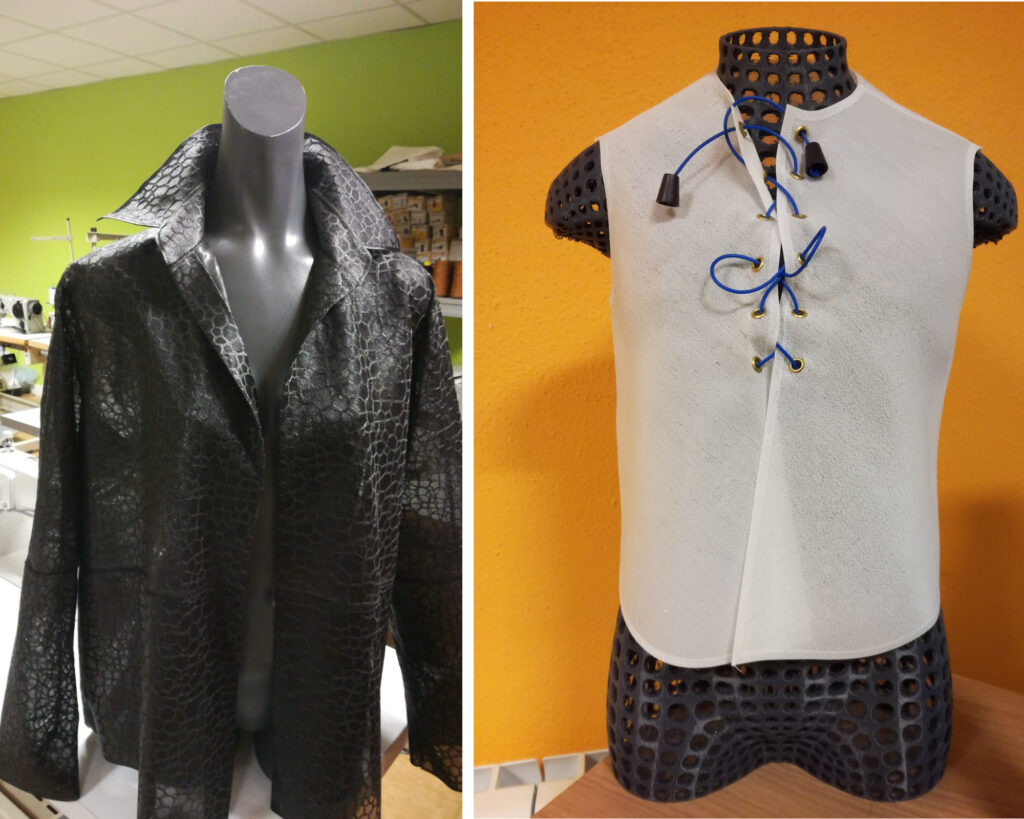
2 examples of garments with soft 3D printed textiles. Photos by Carlos Alonso and Ana Olazabal,Centro de Estudios AEG-Ikastetxea
